
Anyone renting out a Dubai property for short stays needs more than a nice listing. Proper short term rental management starts with a valid DTCM holiday home permit, now issued under the Department of Economy and Tourism, and covers everything from guest safety standards to annual renewals. Skipping this step exposes owners to fines and listing removal from booking platforms. This guide walks through what the licence involves, who needs one, and how it keeps a holiday home compliant and running smoothly through 2026 and beyond.
Short Term Rental Management and the DTCM Licence Explained
Short term rental management covers the operational and regulatory work behind letting a property for stays under six months. The Department of Economy and Tourism, still widely known by its former name DTCM, regulates this activity across Dubai regardless of which platform a guest books through.
The framework applies to:
- Airbnb, Booking.com, and Vrbo listings
- Direct bookings taken through social media or a website
- Any residential unit let for less than six months at a time
A standard Ejari tenancy contract for annual leasing does not cover short stays, so owners need the separate holiday home permit before accepting guests.
Eligibility for a Holiday Home Permit in Dubai
Not every property qualifies automatically, and short term rental property management always begins with confirming eligibility before any listing goes live.
Owners generally need:
- A title deed or sales purchase agreement showing full ownership
- A no-objection certificate from the developer or owners’ association
- A valid DEWA account in the applicant’s name
- Passport or Emirates ID copies for the applicant
Two permit types exist. An individual owner permit suits those managing a single unit directly, while a Holiday Home Operator licence suits companies or individuals handling multiple properties on behalf of owners.
Documents and Standards Required for Licensing
Once eligibility is confirmed, short term rental management shifts toward meeting the physical standards DET expects before granting approval.
Properties must typically be:
- Fully furnished and immediately liveable
- Fitted with working smoke detectors and a fire extinguisher
- Equipped with a first aid kit on site
- Free of any outstanding building or utility violations
DET may inspect the unit to confirm these standards before or shortly after the permit is issued.
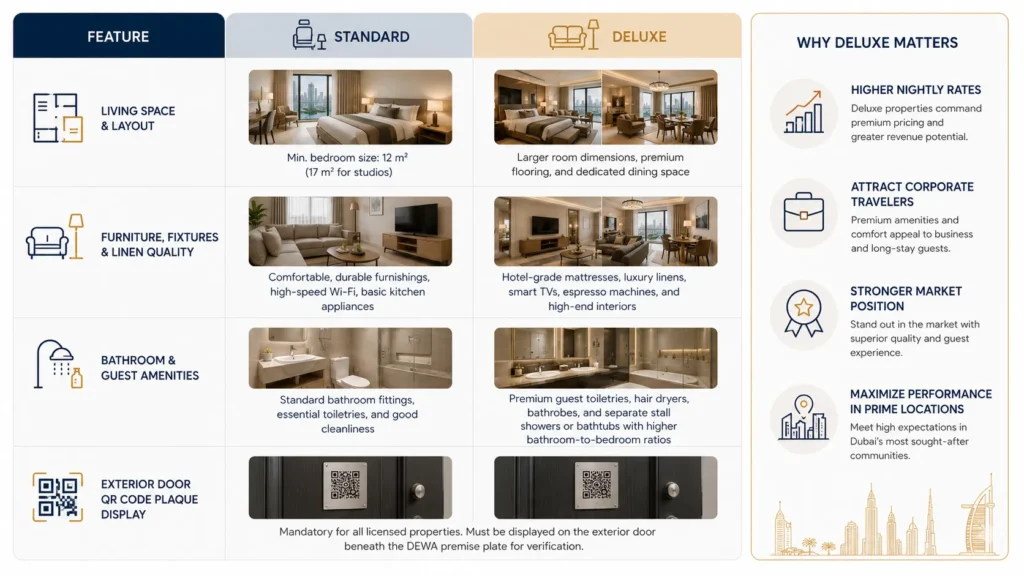
Standard vs. Deluxe Classification: DET Interior and Amenity Guidelines
When navigating short term rental property management, property owners must understand that the Department of Economy and Tourism classifies holiday homes into two distinct tiers: Standard and Deluxe. This classification determines not only your property’s marketing position but also the mandatory amenities and Tourism Dirham rates applied per night.
Key criteria distinguishing standard and deluxe holiday home classifications include:
- Minimum Living Space and Layout Requirements: Standard properties require a minimum bedroom size of 12 square meters (17 square meters for studios), whereas Deluxe units require larger room dimensions, premium flooring finishes, and dedicated dining spaces.
- Furniture, Fixture, and Linen Quality: Standard units must offer comfortable, durable furnishings with high-speed Wi-Fi and basic kitchen appliances. Deluxe classification demands hotel-grade mattresses, luxury linens, smart TVs, espresso machines, and high-end interior aesthetics.
- Bathroom and Guest Amenities: Deluxe units must provide premium guest toiletries, hair dryers, bathrobes, and separate stall showers or bathtubs, alongside higher ratio bathroom-to-bedroom counts.
- Exterior Door QR Code Plaque Display: Every licensed property, regardless of tier, must display an official DET QR code plaque on the exterior door beneath the DEWA premise plate, allowing inspectors and guests to verify active licensing status instantly.
Meeting Deluxe standards allows operators to command higher nightly rates, attract corporate travelers, and maximize long-term rental performance across prime Dubai communities.
Mandatory Guest Security Registration and DET Portal Compliance
A vital legal requirement under str property management in Dubai involves registering guest identities directly with government databases immediately upon check-in. Under DET guidelines, failure to upload verified guest documentation can result in immediate fines or license suspension.
Core guest registration compliance requirements include:
- Mandatory Passport and Emirates ID Verification: Collecting valid passport copies for international tourists or Emirates IDs for UAE residents prior to handing over property keys or digital access codes.
- Three-Hour DET Registration Window: Uploading guest passport details, contact numbers, nationality, and stay dates to the official DET Holiday Homes portal within 3 hours of guest check-in.
- Automated Online Check-In Systems: Professional managers utilize digital check-in tools that capture guest ID scans and perform biometric verification automatically, ensuring instant portal filing without manual delays.
- Automated Data Archiving for Inspections: Maintaining complete, secure digital records of all historical guest stays for a minimum required retention period to satisfy official municipal or security audits.
Enforcing strict digital check-in protocols guarantees continuous compliance with Dubai security mandates, protecting both property owners and incoming guests.
Holiday Let Management Versus Self-Managing Your Licence
Owners can hold their own permit and handle holiday let management personally, or hand daily operations to a licensed operator. Self-managing works for hands-on owners with time to spare, but it means personally tracking renewals, guest registration, and compliance updates.
A professional holiday let management partner instead takes on:
- Permit renewal tracking and paperwork
- Guest registration and reporting obligations
- Coordination between cleaning, maintenance, and DET requirements
Tourism Dirham Collection and Monthly DET Financial Remittance
Operating holiday let management legally in Dubai requires handling the Tourism Dirham fee—a mandatory government fee levied on guests for every night of stay. Accurately tracking, collecting, and remitting this tax is an ongoing operational duty for all permit holders.
Key rules governing Tourism Dirham administration include:
- Tiered Per-Bedroom Daily Rates: The Tourism Dirham fee is charged per bedroom per night. Standard units attract a fee of AED 10 per bedroom per night, while Deluxe units attract a fee of AED 15 per bedroom per night (capped at 30 consecutive nights per booking).
- Separate Line-Item Invoicing: Booking engines and invoices must display the Tourism Dirham fee as a distinct, transparent line item separate from nightly room rates and cleaning fees.
- Monthly Reporting Deadline: Permit holders must submit detailed monthly occupancy reports and remit collected Tourism Dirham funds through the DET portal by the 15th day of each following month.
- Non-Compliance Penalties: Late filings or inaccurate reporting trigger automated penalties from DET and can block annual permit renewal approvals.
Delegating financial administration to a professional short term rental management firm guarantees accurate tax collection and timely monthly submissions, preventing unexpected financial penalties.
STR Property Management Responsibilities After Licensing
Getting licensed is only the starting point. STR property management continues well after approval, since DET compliance is an ongoing obligation rather than a one-time task.
Recurring responsibilities include:
- Renewing the permit annually before expiry
- Keeping guest records for the required retention period
- Updating listings if permit numbers or unit details change
- Reporting accurately for Tourism Dirham collection
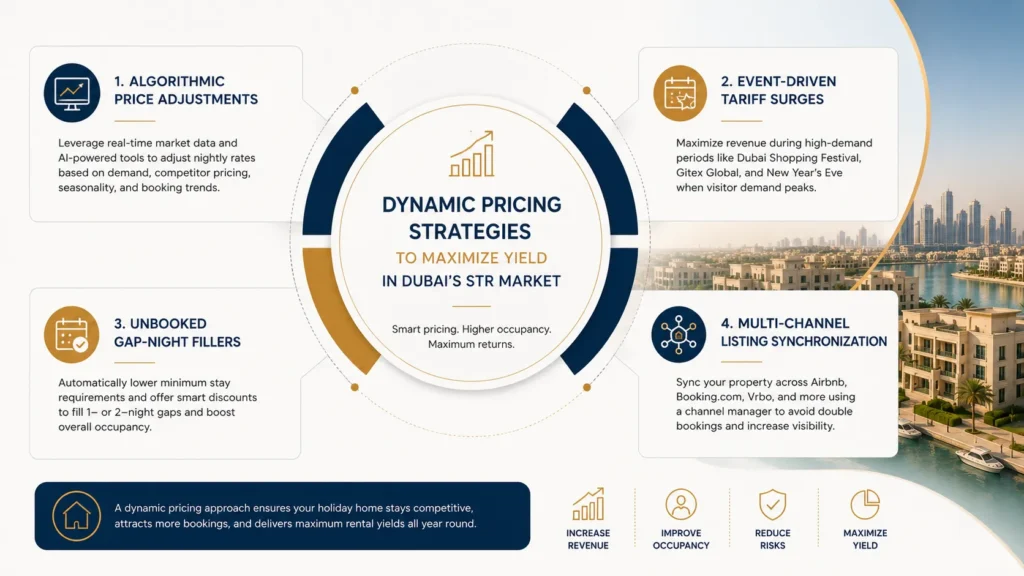
Dynamic Pricing Strategies to Maximize Yield in Dubai’s STR Market
Securing a holiday home licence opens the door to revenue potential, but maximizing net returns requires sophisticated vacation rental management strategies. In a dynamic market like Dubai, static nightly rates lead to missed earnings during peak seasons or unbooked gap days during quieter periods.
Professional revenue optimization techniques under short term rental property management include:
- Algorithmic Price Adjustments: Utilizing real-time market data software to adjust nightly rates based on neighborhood demand, competitor availability, and seasonal travel surges.
- Event-Driven Tariff Surges: Increasing pricing during major Dubai events, trade shows, and holidays—such as the Dubai Shopping Festival, Gitex Global, and New Year’s Eve-when tourist demand peaks in central hubs like Downtown Dubai and Palm Jumeirah.
- Unbooked Gap-Night Fillers: Automatically lowering minimum stay rules and offering targeted discounts to fill 1- or 2-night calendar gaps between existing reservations.
- Multi-Channel Listing Synchronization: Synchronizing property calendars across top booking channels—including Airbnb, Booking.com, and Vrbo—using centralized channel managers to prevent double bookings while maximizing listing visibility.
Applying these strategic revenue management methods ensures your holiday home maintains high occupancy rates and delivers optimal annual rental yields.
Vacation Rental Management and Ongoing Compliance
Vacation rental management ties licensing to day-to-day performance, since a compliant property still needs strong pricing, guest care, and turnover to earn well. Owners who separate compliance from operations often find gaps appear between the two.
Regent Elite Properties structures its short term rental property management around this exact link, keeping licensing current while also handling guest experience across Dubai’s key communities.
Insurance Requirements and Risk Management for Short-Term Rentals
A critical aspect of str property management that self-managing owners frequently overlook is securing comprehensive insurance coverage specifically tailored for short-stay operations. Standard landlord insurance policies or Ejari-based home coverage typically explicitly exclude commercial short-term guest activities.
Essential insurance safeguards for Dubai holiday homes include:
- Property Contents and Furnishing Protection: Securing policies that cover accidental damage, stained upholstery, damaged electronic appliances, or broken fixtures caused during guest stays.
- Third-Party Public Liability Coverage: Maintaining comprehensive public liability insurance to protect property owners against guest injury claims occurring within the unit or private balcony spaces.
- Building Structural and Loss-of-Income Coverage: Ensuring coverage accounts for major unpredicted events, such as water pipe bursts or electrical fires, covering both physical repairs and lost rental revenue during restoration.
- Security Deposit Authorizations: Holding refundable guest security deposits via digital payment gateways prior to check-in to cover minor breakage or missing items seamlessly.
Establishing robust risk management protocols protects physical assets and maintains long-term investor peace of mind.
Let Regent Elite Properties Handle Your Licence and Bookings
If DTCM paperwork and renewal deadlines feel like a distraction from actually earning, professional support can close that gap. Regent Elite Properties offers short term rental management that keeps your holiday home compliant, presentable, and consistently booked. Reach out to discuss your property and current permit status.
Conclusion
A valid DTCM holiday home permit is the foundation of any short-let property in Dubai, but short term rental management does not stop at licensing. From eligibility and documentation to ongoing compliance and guest care, owners need a system that covers the full cycle of vacation rental management. Whether you choose holiday let management personally or through STR property management support, treat the licence as the beginning of the process, not the end of it.
Frequently Asked Questions:
Short term rental management covers licensing, compliance, guest handling, and property upkeep for holiday homes let under DET’s holiday home permit framework.
Yes, any property let for under six months requires a valid holiday home permit from DET, formerly DTCM, regardless of the booking platform used.
Holiday let management involves permit compliance, guest registration, and frequent turnover, while long-term leasing relies on an annual Ejari tenancy contract instead.
Yes, individual owners can hold their own permit and self-manage, though a Holiday Home Operator licence suits those managing multiple properties.
Owners typically need a title deed, Emirates ID or passport, a no-objection certificate, and a valid DEWA account before applying.
Many owners find it useful, since a manager can track renewals, guest registration, and compliance while also handling pricing and guest care.

