Owning a rental property in Dubai eventually brings up one central question: should you manage it yourself, or hand the work to a private property management company? Both routes are common among landlords across Dubai Marina, Downtown, and the emerging freehold communities.
Self-management offers control. Private property management offers convenience, compliance support, and time back in your calendar. This guide looks honestly at both approaches, including realistic property management cost expectations, so you can decide what suits your property, your schedule, and your investment goals.
Understanding Private Property Management in Dubai
Private property management refers to a licensed company handling the operational side of a rental property on an owner’s behalf. This typically covers tenant sourcing, rent collection, maintenance coordination, and RERA-related paperwork such as Ejari registration.
In a market as active as Dubai’s, where tenancy laws, service charges, and building regulations shift regularly, private property management has become a practical option for owners who live abroad, hold multiple units, or simply prefer not to field tenant calls at midnight.
Dubai’s Legal and Regulatory Framework: What Landlords Must Know
Navigating the legal framework in Dubai requires staying current with Real Estate Regulatory Agency (RERA) standards and Dubai Land Department (DLD) mandates. Under Law No. 26 of 2007 (and its amendment Law No. 33 of 2008), the relationship between landlords and tenants is strictly governed to protect both parties.
Key legal requirements every owner should understand include:
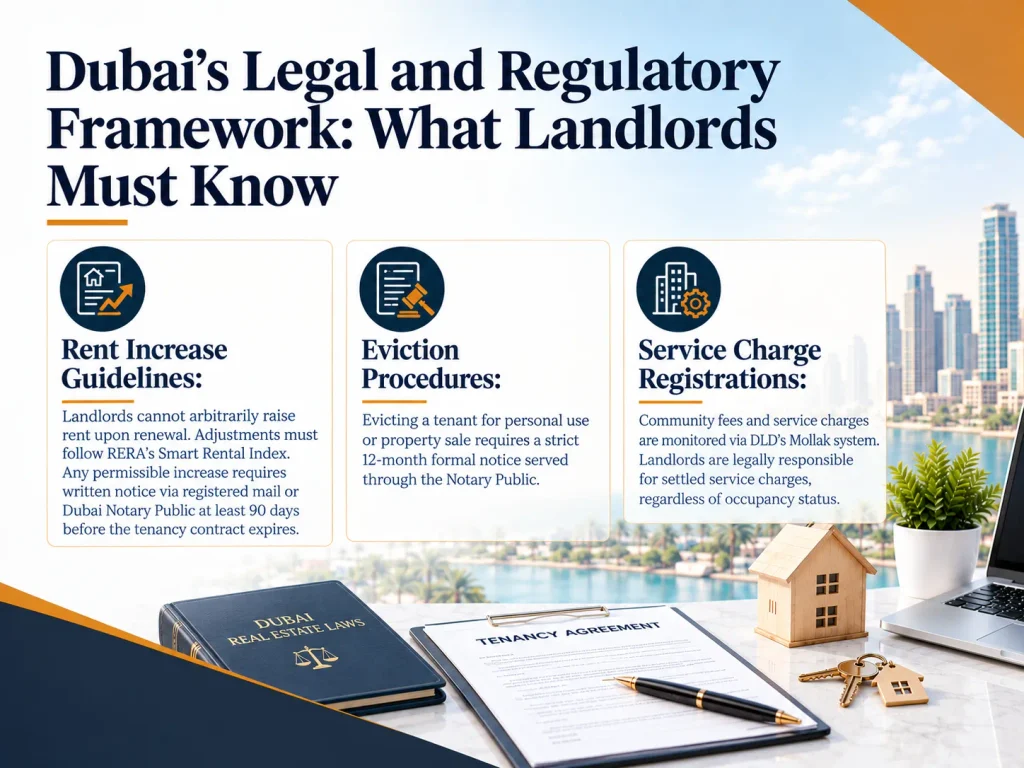
- Rent Increase Guidelines: Landlords cannot arbitrarily raise rent upon renewal. Adjustments must follow RERA’s Smart Rental Index. Any permissible increase requires written notice via registered mail or Dubai Notary Public at least 90 days before the tenancy contract expires.
- Eviction Procedures: Evicting a tenant for personal use or property sale requires a strict 12-month formal notice served through the Notary Public.
- Service Charge Registrations: Community fees and service charges are monitored via DLD’s Mollak system. Landlords are legally responsible for settled service charges, regardless of occupancy status.
For landlords who choose to manage my property directly, staying fully compliant with these evolving legal structures demands constant monitoring. A professional property management agency ensures all notices, Ejari documents, and lease terms adhere strictly to current DLD guidelines, minimizing legal exposure at the Rental Dispute Settlement Centre (RDC).
Running Your Rental Property Without Outside Help
Self-management means the owner personally handles every stage of the rental cycle. It works best for landlords with one property, local availability, and genuine interest in the administrative side of letting.
Day-to-Day Tasks Owners Handle Alone
Owners who choose to manage my property themselves usually take on the following tasks.
- Advertising the unit and screening prospective tenants
- Negotiating rent and preparing the tenancy contract
- Registering the lease through Ejari
- Collecting rent and chasing late payments
- Coordinating repairs, cleaning, and emergency call-outs
- Handling renewals, disputes, and move-out inspections
Weighing the Pros and Cons of Self-Management
Strengths of Managing a Property Yourself
- Full control over tenant selection and property presentation
- No management fee, which can matter for a single unit
- Direct relationship with tenants, useful for long-term lets
- Flexibility to make quick decisions without third-party sign-off
Limitations of Self-Managing a Rental
- Time-consuming, particularly during renewals or vacancy periods
- Legal and compliance knowledge must be kept current
- Harder to manage from outside the UAE
- Emergency maintenance calls can happen at inconvenient hours
- Limited negotiating power with contractors and suppliers
Long-Term Residential vs. Short-Term Holiday Homes Strategy
When deciding how to manage my property, landlords in Dubai must also decide between long-term leasing (annual tenancy) and short-term holiday home rentals. Each strategy presents distinct operational demands:
- Regulatory Body: Long-term leases fall strictly under the jurisdiction of RERA / Dubai Land Department, whereas short-term rentals are governed by the Department of Economy and Tourism (DET).
- Contract Structure: Long-term lets rely on an annual Ejari contract paid via 1–4 rent cheques. Short-term rentals operate on flexible daily, weekly, or monthly booking agreements.
- Maintenance Burden: Long-term units require occasional major repairs with routine care handled by the tenant. Short-term units require continuous housekeeping, turnover cleaning, and linen service between guest stays.
- Management Time: Annual rentals carry a low to moderate ongoing time requirement. Holiday homes demand high-intensity, 24/7 guest communication and check-in management.
- Yield Potential: Annual leases offer a stable, predictable yield. Short-term rentals deliver higher potential gross yields, though subject to seasonal occupancy shifts in Dubai.
While short-term rentals can generate higher gross revenue in popular hubs like Palm Jumeirah or Downtown Dubai, they require intensive operational oversight. Engaging private property management allows owners to capitalize on short-term rental yields without turning property ownership into a full-time job.
Professional Property Management Support for Landlords
Professional property management removes the operational burden from the owner and places it with a team that handles rentals daily. A private property management company typically brings the following advantages.
- Established tenant networks and faster void periods
- RERA-compliant contracts and updated documentation
- Scheduled maintenance and vetted contractor relationships
- Rent collection systems with clear reporting
- Support with disputes, renewals, and Ejari processes
- Market insight on achievable rent for the area
For overseas owners, portfolio holders, or landlords without spare time, professional property management often becomes less of a luxury and more of a practical necessity.
Maximizing Rental Yields and Minimizing Void Periods
The true financial value of professional property management extends beyond administrative convenience; it directly impacts net investment yields. Maximizing rental income in Dubai’s competitive real estate market requires more than just owning a property. Unplanned vacancy is often the single largest drain on rental returns in Dubai.
Professional managers preserve asset value and protect cash flow through:
- Strategic Pricing Intelligence: Utilizing real-time market data rather than outdated portal listings to set competitive rents that attract high-caliber tenants quickly.
- Proactive Renewal Management: Initiating lease renewal discussions 90 to 120 days before contract expiry, ensuring smooth transitions or timely re-marketing.
- Preventative Maintenance Protocols: Conducting regular property inspections to address minor maintenance issues before they turn into costly emergency repairs or tenant disputes.
- Tenant Retention Programs: Maintaining professional, responsive communication to encourage long-term lease renewals, reducing costly unit turnover expenses.
By keeping vacancy windows minimal and preventing deferred maintenance issues, professional property management consistently helps landlords secure higher net returns over a multi-year holding period.
Comprehensive Tenant Vetting and Financial Safeguards
Beyond handling daily repairs and routine leases, one of the primary responsibilities of professional property management is mitigating landlord risk through structured screening and legal financial safeguards. Finding reliable tenants directly protects your physical asset and ensures consistent rental cash flow.
A dedicated private property management firm protects your property through multi-layered screening protocols:
- Identity and Financial Verification: Verifying employment status, income streams, banking credentials, and UAE residency status (or passport documentation for incoming expats) to confirm long-term stability.
- Security Deposit and Cheque Management: Structuring rental payments via verified cheque schedules or direct banking transfers, and managing security deposits strictly within RERA compliance limits (5% for unfurnished and 10% for furnished properties).
- Photographic Handover Inspection Reports: Documenting comprehensive move-in condition reports with high-resolution photos. This creates an undeniable paper trail that eliminates dispute complications regarding security deposit deductions at move-out.
- Legal Default Protection: Establishing clear, compliant workflows to address delayed rent payments promptly, ensuring full adherence to RERA’s 30-day legal notice periods if official dispute proceedings become necessary.
Enforcing these tenant vetting standards provides landlords with complete security, ensuring their unit is maintained respectfully and occupied by verified, financially sound tenants.
Property Management Cost Factors to Understand
Property management cost in Dubai is usually structured as a percentage of the annual rental value, rather than a flat figure, and it varies depending on the scope of service. Several factors influence property management cost.
- Number of units under management
- Property type, size, and location
- Whether the service includes maintenance coordination
- The level of reporting and tenant communication required
- Additional services such as short-let management or renovation oversight
Rather than comparing this cost in isolation, it helps to weigh it against the time saved, the reduced vacancy risk, and the compliance protection a professional team provides.
Evaluating the Financial Picture: Hidden Costs of Self-Management
When evaluating property management cost, landlords often compare the management fee percentage directly against zero. However, self-managing a Dubai rental carries hidden financial costs that are easy to overlook:
- Extended Vacancy Costs: A unit sitting vacant for just 4 weeks while an owner attempts to handle viewings around personal commitments represents roughly an 8.3% loss in annual rental revenue—frequently exceeding the entire annual fee of a management firm.
- Overpriced Maintenance Calls: Individual owners rarely command volume discounts with air conditioning, plumbing, or electrical contractors, often paying premium retail rates for emergency call-outs.
- Deposit and Dispute Expenses: Errors made during move-out inspections or improper security deposit deductions can lead to official cases before the Rental Dispute Settlement Centre (RDC), incurring filing fees and valuable lost time.
- Banking and FX Fees: International landlords self-managing remote collection often incur significant cross-border transaction fees and unfavorable currency conversion rates on physical cheque processing.
When factoring in these operational friction points, partnering with a professional property management team frequently pays for itself through operational savings and void-period reduction.
Choosing Between Self-Management and Professional Property Management
The right choice depends on a few honest questions about your situation. If you enjoy hands-on control, you may prefer to manage my property directly rather than outsource it.
- Portfolio size: One unit is manageable alone; multiple units rarely are.
- Location: Owners living outside the UAE benefit most from professional property management.
- Time availability: Weigh your schedule against tenant demands realistically.
- Risk tolerance: Compliance errors can be costly to correct later.
- Long-term goals: Growing a portfolio usually calls for outside support.
Many landlords start by self-managing a first property, then move to private property management once their portfolio, or their patience, grows.
Partner With Regent Elite Properties for Professional Guidance
Ready to stop chasing rent and start reviewing reports instead? Regent Elite Properties supports Dubai landlords with structured, transparent private property management, covering tenant sourcing, compliance, and day-to-day coordination. Whether you own one apartment or a growing portfolio, our advisory team can help you decide the right path forward and manage the process from there.
Conclusion
There is no single correct answer to self-managing versus hiring private property management. Owners with time, local presence, and one property often manage comfortably alone. Owners with multiple units, overseas addresses, or limited availability tend to benefit from professional property management instead. Understanding property management cost, weighing it against your time and risk tolerance, and being honest about your availability will point you toward the right decision for your investment.
Frequently Asked Questions
For owners with limited time, multiple units, or overseas addresses, it usually is. It reduces vacancy periods, compliance risk, and day-to-day workload.
It generally covers tenant sourcing, rent collection, maintenance coordination, and compliance support, often charged as a percentage of annual rent.
Owners can self-manage their own property without a broker licence, provided they handle Ejari registration and RERA compliance correctly.
No. Local owners with multiple properties or limited free time also benefit from professional property management and its structured processes.
Consider your portfolio size, location, available time, and comfort with compliance paperwork before deciding which approach suits you.
Yes, most private property management companies handle renewals, disputes, and move-out inspections on the owner’s behalf, reducing direct involvement.