
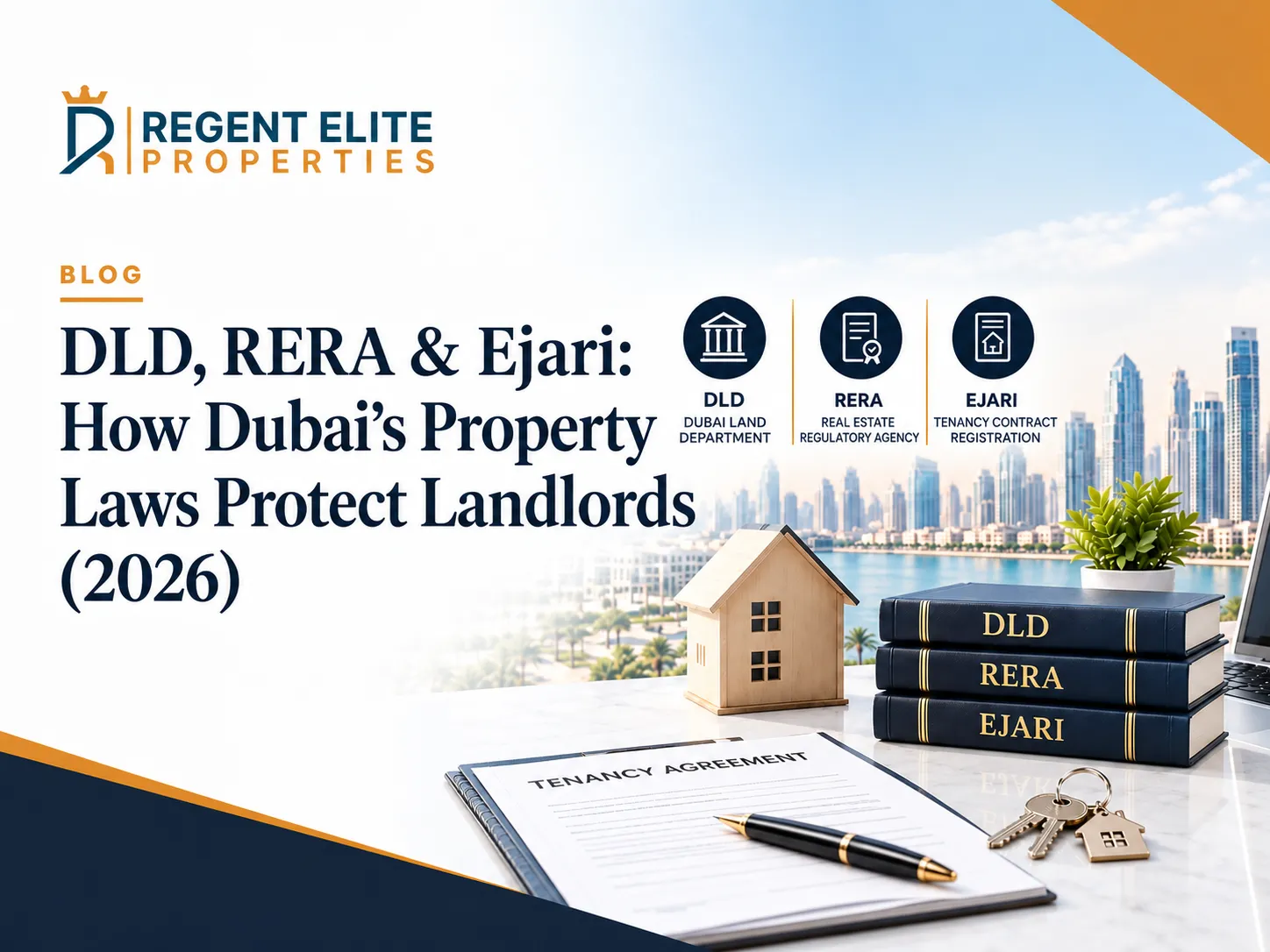
Dubai’s rental market runs on structure, not guesswork. Every tenancy sits within a framework built on DLD, its regulatory arm, and the mandatory registration system landlords rely on daily. Understanding Ejari and RERA is essential for any property owner who wants enforceable contracts, predictable rent increases, and real protection if a dispute ever reaches the Rental Disputes Centre.
This guide breaks down how DLD, RERA, and Ejari work together, what landlord rights Dubai owners can actually rely on, and what RERA Dubai 2026 changes mean for property compliance.
Understanding RERA and Ejari in Dubai’s Rental Framework
DLD is the government authority overseeing all real estate activity in the emirate, from title registration to tenancy regulation. RERA operates as the regulatory arm of DLD, administering rental legislation, licensing brokers, and maintaining the Smart Rental Index.
Ejari, meaning “my rent” in Arabic, is the mandatory online system that registers every tenancy contract under DLD oversight. Without Ejari, a lease carries no legal standing, and neither RERA nor the Rental Disputes Centre will enforce it. Together, these three pillars give landlords a documented, defensible position whenever a tenancy issue arises.
How the AI-Powered Smart Rental Index Calculates Rent Increments
Understanding RERA Dubai 2026 updates requires examining how the Dubai Land Department evaluates property valuations. Rather than relying on broad community averages, RERA’s enhanced Smart Rental Index utilizes real-time transaction data and building-level criteria to establish fair market rents.
When evaluating permissible rent adjustments under Decree No. 43 of 2013, the Smart Rental Index considers specific property parameters:
- Building Quality and Age: Rating individual building maintenance standards, age, and physical condition.
- Location and Community Demand: Assessing localized real-time transaction figures and neighborhood demand.
- Unit Type and Amenities: Factoring in specific floor levels, square footage, parking allocations, and building amenities like gyms or pools.
- Tiered Rent Increase Caps: Enforcing statutory cap thresholds based on how far current rent sits below market averages (0% increase if under 10% below market; max 20% increase if over 40% below market).
Utilizing official RERA calculator benchmarks ensures rent adjustments are legally sound and protected against tenant challenges before the Rental Disputes Centre.

The Legal Foundation Behind Landlord Rights Dubai
Key Laws Governing Dubai Tenancies
Dubai’s tenancy framework rests on a handful of core legal instruments.
- Law No. 26 of 2007 established the original relationship between landlords and tenants.
- Law No. 33 of 2008 amended provisions on rent increases and eviction notices.
- Decree No. 43 of 2013 introduced the tiered rent increase calculator tied to the Rental Index.
- The Rental Disputes Centre resolves conflicts outside standard courts, under DLD oversight.
These instruments give landlord rights Dubai owners depend on genuine legal weight, rather than informal custom.
Ejari Registration and Why It Matters for Landlords
Ejari registration formalises a tenancy contract with DLD, and it protects landlords as much as tenants. Registration must generally happen within 30 days of signing, and skipping it can mean fines and a weaker position at the Rental Disputes Centre.
Ejari registration matters because it prevents fraudulent double-renting, confirms the agreed rent for future increase calculations, and supports DEWA activation and tenant visa processes. From 2026 onward, all co-occupants living in a property must be registered within seven days of moving in, giving landlords a clearer DLD-backed record of occupancy.
Read our Ejari registration guide to get more insights.
2026 Dubai Shared Housing Law: Mitigating Unauthorized Subletting Risks
Maintaining a valid Ejari registration is closely connected to enforcing occupancy standards across residential properties. Under Dubai Law No. 4 of 2026 (the Shared Housing Law), regulations prohibit unauthorized room partitioning, bed-space subletting, and unapproved co-living arrangements.
Key compliance rules landlords must understand regarding occupancy include:
- Written Subletting Approval Required: Tenants cannot sublet any portion of a leased property without explicit written consent from the landlord.
- Mandatory Co-Occupant Registration: All secondary occupants, family members, or long-term residents must be formally added to the Ejari system.
- Permit Requirements for Shared Housing: Operating shared housing or sub-leased accommodations requires official permits from Dubai Municipality and DLD, with strict occupancy limits.
- Fines for Unlawful Subletting: Unapproved sub-leasing or over-occupancy triggers substantial administrative penalties ranging from AED 500 up to AED 1 million for repeat offenses.
Strict adherence to Ejari co-occupant registration rules protects landlords from building safety liabilities, unauthorized structural modifications, and severe municipal fines.
How RERA Dubai 2026 Protects Landlord Interests
RERA Dubai 2026 continues to sharpen the balance between tenant protection and landlord certainty. The Smart Rental Index sets clear, data-backed bands for allowable rent increases, so a compliant landlord’s increase cannot be challenged as arbitrary. RERA rules also give landlords defined, lawful routes to reclaim a property for personal use or sale, provided proper notice is served.
- Landlord rights Dubai owners can rely on under the current framework include the following.
- The right to increase rent within Smart Rental Index bands with proper notice
- The right to reclaim a property for personal use or resale with twelve months’ written notice
- The right to pursue unpaid rent or contract breaches through the Rental Disputes Centre
- The right to retain part of a security deposit for damage beyond normal wear and tear
- Protection from unauthorised subletting when the contract prohibits it
RERA also holds tenants accountable, which strengthens a compliant landlord’s position considerably.
Resolving Tenancy Conflicts via the Rental Disputes Centre (RDC)
Even with clear legal contracts, disputes regarding unpaid rent, delayed cheque clearance, or illegal property modifications can arise. Under the supervision of the Dubai Land Department, the Rental Disputes Centre (RDC) functions as the judicial body dedicated to resolving landlord-tenant grievances.
Key procedures governing RDC claims include:
- Prerequisite Ejari Verification: The RDC will not register or hear claims involving tenancy contracts that lack official Ejari registration.
- Pre-Trial Reconciliation Procedures: First-instance claims undergo initial mediation sessions where official reconciliation officers attempt to reach amicable settlements.
- 30-Day Default Notice Enforcement: If a tenant fails to pay agreed rent, landlords must issue a formal written notice giving 30 days to remedy the payment default before filing for lease termination.
- Enforceable Judgments: RDC rulings carry binding legal weight, authorizing formal financial recovery, bank account attachments, or police-assisted eviction enforcement if required.
Having proper Ejari registration and notary-served notices ensures landlords can defend their financial interests swiftly before the RDC.
DLD Mollak System Integration and Service Charge Transparency
Another key layer of regulatory oversight governing real estate asset management is DLD’s Mollak platform. Designed to manage jointly owned property developments, Mollak standardizes community service fees and building maintenance accounts across Dubai.
Key compliance aspects of the Mollak system for property owners include:
- Audited Service Fee Invoicing: All building management service fees must be approved by the Dubai Land Department and issued electronically through Mollak.
- Landlord Service Charge Responsibility: Landlords remain legally responsible for paying approved Mollak service fees on time, regardless of property occupancy or tenant status.
- Pre-requisite for Property Transfers and Ejari: Unpaid building service charges logged in Mollak can block the issuance of developer No Objection Certificates (NOCs) during property sales or affect registration workflows.
- Transparent Maintenance Fund Allocation: Ensuring community fees directly fund building insurance, security, and preventative maintenance, preserving structural asset values over time.
Tracking Mollak statements guarantees that properties remain in good standing with building management and DLD registration systems.
DLD’s Role in Safeguarding the Wider Property Market
While RERA manages the day-to-day rental relationship, DLD sits above it, safeguarding the wider market. DLD maintains the title registry, licenses real estate professionals, and ensures every transaction is traceable and enforceable.
A property with clean DLD records, accurate Ejari history, and proper documentation is easier to sell, mortgage, or transfer later. RERA Dubai 2026 updates increasingly link these systems together, so a gap in one area, such as missing Ejari registration, can surface as a complication elsewhere.
Practical Compliance Steps for Landlords
Staying compliant does not require legal training, just consistent habits.
- Register every tenancy contract on Ejari within 30 days of signing
- Register all co-occupants within the required timeframe
- Use the RERA Rental Index calculator before issuing any rent increase
- Serve notice through notary public or registered mail, never verbally
- Keep receipts, maintenance records, and correspondence in writing
- Return security deposits within 30 days of lease end, minus documented damage
Following these steps keeps a landlord’s position strong if a dispute ever reaches the Rental Disputes Centre.
Document Preservation Protocols for Audit-Ready Management
To maintain full protection under landlord rights Dubai laws, property owners should keep structured digital and physical records for every unit in their portfolio. If legal proceedings or municipal inspections occur, presenting an organized paper trail is essential for a favorable resolution.
Essential documentation protocols include:
- Signed Form F (MOU) and Tenancy Contracts: Archiving original lease agreements containing clear clauses prohibiting unauthorized alterations or unapproved sub-leasing.
- Official Notary Public Notices: Retaining stamped courier receipts and Notary Public certificates for all 90-day rent adjustment notices or 12-month eviction notices.
- Move-In/Move-Out Photographic Audits: Documenting high-resolution, time-stamped photos of unit conditions before handover to substantiate security deposit deductions for physical damage.
- Payment Logs and Bank Statements: Maintaining organized records of post-dated cheques, digital bank transfer receipts, and security deposit transactions.
Establishing rigorous document archiving practices ensures your property portfolio remains completely compliant and audit-ready at all times.
Let Regent Elite Properties Handle Your Compliance
Managing Ejari renewals, RERA notices, and DLD paperwork across multiple units takes time most landlords would rather spend elsewhere. Regent Elite Properties supports Dubai property owners with structured compliance, accurate Ejari registration, and RERA-aligned tenancy management, so your rights stay protected without the paperwork falling on you. Whether you own a single apartment or a growing portfolio, our team keeps your DLD documentation audit-ready at every stage.
Conclusion
Dubai’s rental framework gives landlords real, enforceable protection, but only when the paperwork is correct. RERA and Ejari work together to validate every tenancy, while DLD anchors the wider property record behind it. Landlord rights Dubai owners can lean on, from rent increase limits to eviction notice periods, only hold up when Ejari registration and notices are handled properly and on time. As RERA Dubai 2026 rules continue tightening enforcement, treating DLD compliance as routine, rather than an afterthought, is what keeps a landlord’s position genuinely secure.
Frequently Asked Questions
Yes, every tenancy contract must be registered through Ejari. Without it, RERA and the Rental Disputes Centre cannot enforce the agreement.
DLD is the overarching government authority for real estate. RERA is its regulatory arm, handling rental legislation and licensing.
Landlords must give at least 90 days’ written notice before contract expiry, using the RERA Rental Index to calculate the allowed increase.
No. Eviction generally requires twelve months’ written notice through notary public or registered mail, even at contract expiry.
An unregistered contract has no legal standing. Landlords cannot enforce it through the Rental Disputes Centre or access related services.
Yes, landlords must return deposits within 30 days of lease end and cannot deduct amounts for normal wear and tear.