
Evaluating rental strategies in Dubai requires assessing revenue potential against daily operational needs. Property owners choosing between short-term stays and long-term tenancies must examine market dynamics, occupancy fluctuations, and ongoing administrative requirements. Utilizing professional holiday home management allows landlords to capitalize on Dubai’s thriving tourism market while maintaining asset flexibility. Concurrently, long-term leasing offers consistent cash flow with lower administrative overhead. This guide explores both revenue strategies to help property owners select the optimal management model with Regent Elite Properties.
Evaluating Revenue Potentials and Market Demand Dynamics
Choosing between short-term guest hosting and year-long residential contracts directly impacts overall annual earnings and overall rental yield Dubai metrics.
Dynamic Pricing Versus Fixed Annual Income
Short-term properties leverage variable daily pricing tailored to peak tourist seasons, events, and local holidays. Conversely, standard annual tenancies deliver fixed payments guaranteed through registered Ejari contracts, providing reliable revenue projections regardless of season.
Tourism Growth Impacting Short-Term Revenue
Dubai continues drawing global travelers, keeping tourist hotspots like Downtown Dubai, Dubai Marina, and Palm Jumeirah in high demand. Properties situated near prime leisure districts benefit significantly from seasonal rate increases.
Population Influx Fueling Residential Contracts
Corporate relocations and long-term residency schemes sustain constant demand for annual housing. Suburbs and family-centric communities yield reliable returns under standard long-term agreements.
Dynamic Pricing Strategies: Capturing Peak Season Spikes
A primary catalyst driving superior gross revenue in short-term leasing is the implementation of dynamic pricing algorithms. Unlike long-term rentals where rent remains locked for 12 months, short-term rates adjust fluidly based on real-time market supply, seasonal demand, and major events in Dubai.
Key factors that dynamic holiday home management leverages to boost yield include:
- High-Season Rate Maximization: Capitalizing on peak tourist months (October through April) when nightly rates in prime hubs like Downtown Dubai and Dubai Marina double or triple.
- Event-Driven Price Surges: Adjusting nightly tariffs upwards during major international events, exhibitions, and holiday periods such as Gitex Global, Dubai Shopping Festival, and New Year’s Eve.
- Minimum Stay Length Optimization: Setting strategic minimum stay policies (e.g., 3-night minimums during weekends and 7-night minimums during peak holidays) to eliminate gap days between guest bookings.
- Automated Yield Management Systems: Utilizing specialized price-matching software that monitors rival property calendars across Airbnb, Booking.com, and VRBO, automatically tuning rates to secure maximum occupancy at peak prices.
By actively adjusting nightly pricing rather than relying on static rates, professional vacation rental management ensures landlords capture top-tier revenue throughout the year.
Operational Requirements in Short Term Property Management
Operating short-term lets requires substantial administrative oversight, strict regulatory compliance, and active guest relations. Selecting specialized holiday home management transfers these day-to-day burdens to experienced professionals.
Key operational considerations include:
- DET Licensing Compliance: Registering units with the Dubai Department of Economy and Tourism and remitting Tourism Dirham fees.
- Active Guest Support: Handling round-the-clock check-ins, guest queries, housekeeping, and linen servicing.
- Listing Optimization: Managing multi-channel bookings across platforms like Airbnb and Booking.com with real-time pricing tools.
Partnering with professional vacation rental management ensures properties maintain high review scores, strong search visibility, and maximum occupancy rates.
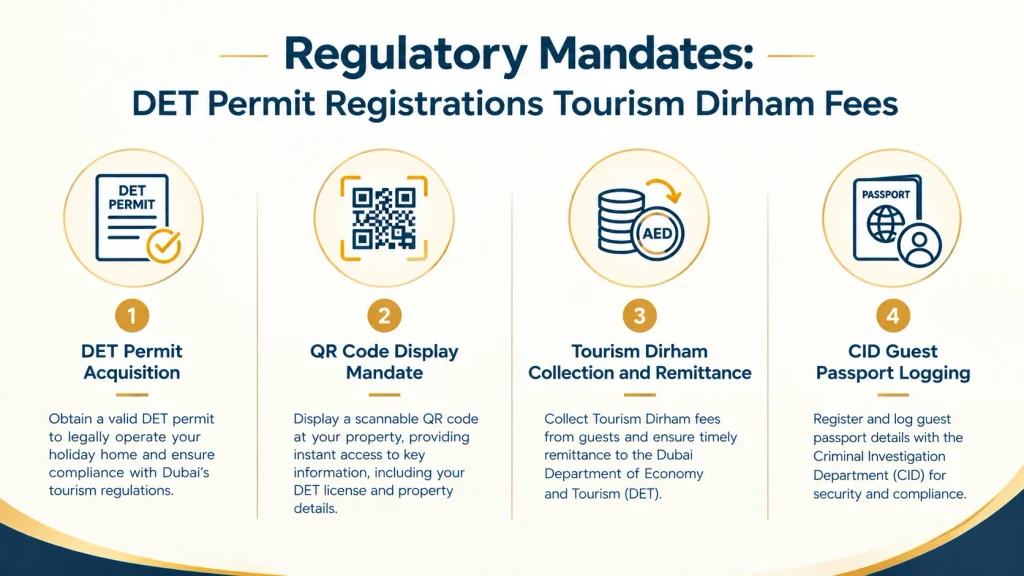
Regulatory Mandates: DET Permit Registrations Tourism Dirham Fees
Operating short term property management in Dubai requires strict adherence to legal mandates established by government regulatory authorities. Landlords cannot list residential apartments as holiday homes without obtaining official licenses and registering every booking.
Essential regulatory compliance steps include:
- DET Permit Acquisition: Obtaining a valid Holiday Home Permit from the Department of Economy and Tourism (DET) before marketing the unit on any public booking platform.
- QR Code Display Mandate: Displaying an official DET-issued QR code inside the unit and on all digital listings to verify legal registration status during municipal inspections.
- Tourism Dirham Collection and Remittance: Collecting mandatory Tourism Dirham fees from guests per night (varying from AED 10 to AED 15 per bedroom depending on property classification) and remitting funds monthly to DET.
- CID Guest Passport Logging: Registering guest passport details on the official Dubai Police/CID portal prior to check-in to satisfy national security requirements.
Failing to comply with DET rules can result in steep administrative fines. Full-service holiday home management firms handle all permit filings, monthly fee remittances, and police portal entries directly on behalf of the owner.
Analyzing Expense Structures and Maintenance Demands
Net profitability depends heavily on operating expenses, utility coverage, and ongoing maintenance duties under each business model.
Utility and Furnishing Obligations
Short-term landlords cover all utility accounts, internet subscriptions, building service charges, and initial luxury interior design. Long-term tenancies transfer utility payments directly to occupants via DEWA registrations.
Wear, Tear, and Routine Maintenance
High guest turnover necessitates frequent deep cleaning, cosmetic upkeep, and continuous minor repairs. Professional short term property management mitigates property wear through regular inspections and rapid maintenance interventions.
Net Financial Modelling: Realistic Cost Breakdown Comparison
To evaluate whether a vacation rental outperforms an annual lease, landlords must calculate net returns after factoring in operating expenses. While short-term rentals frequently generate 20% to 40% higher gross income, their ongoing expense structures differ significantly from long-term leases.
A comparative net income breakdown reveals how operational costs shape net rental yield Dubai performance:
- Utility Responsibilities: Short-term landlords cover DEWA (water and electricity), high-speed Wi-Fi, and district cooling (Empower/Emicool), whereas long-term tenants pay these directly.
- Property Management Commissions: Short term property management fees typically range between 15% and 20% of gross revenue (covering marketing, guest support, and turnover management), compared to 5% to 8% for long-term lease management.
- Housekeeping and Cleaning Costs: Short-term operations require professional cleaning and linen turnover services between guest stays, though these costs are usually passed directly to the guest as a separate cleaning fee.
- Building Service Charges: Owners under both models remain legally responsible for annual master community service fees processed via DLD’s Mollak system.
When executed in prime tourist locations with high occupancy rates, short-term rentals consistently yield higher net returns despite higher operational overhead.
Selecting the Ideal Rental Strategy for Your Portfolio
Selecting between dynamic short-term stays and predictable annual leases involves balancing personal usage preferences, location advantages, and risk tolerances.
- Location Considerations: Apartments in high-density tourist hubs perform exceptionally well as vacation rentals. Inland residential communities typically suit long-term tenants.
- Owner Access Flexibility: Holiday lets landlords personally access their real estate during vacant windows throughout the year.
- Management Involvement: Comprehensive holiday home management completely automates guest communication, pricing, and guest checks.
Property Styling and Interior Design: Transforming Units for High Occupancy
In the competitive short-term market, unit presentation directly impacts click-through rates, booking conversion, and average daily rates (ADR). Properties styled with luxury furnishings and professional interior staging command higher prices and secure better guest reviews.
Key interior design strategies implemented by vacation rental management experts include:
- Hotel-Grade Furniture and Linen Standards: Equipping units with durable, commercial-grade furniture, high-thread-count linens, and premium mattresses to ensure guest comfort and withstand frequent use.
- Targeted Theme and Aesthetic Appeal: Utilizing coastal, contemporary, or minimalist interior concepts that photograph exceptionally well for digital listing portals like Airbnb.
- Essential Guest Amenities: Providing high-demand amenities such as coffee machines, smart TVs, dedicated workspaces, and luxury bathroom toiletries that earn 5-star review badges.
- Professional HDR Photography and Virtual Tours: Capturing wide-angle, professionally lit images that showcase space, view, and lighting, ensuring listings rank higher on search algorithms.
Investing in high-quality interior staging allows property owners to differentiate their listings, increase occupancy rates, and accelerate overall return on investment.
Risk Mitigation and Guest Screening Protocols
A common concern among landlords considering short term property management is the potential for property damage or unauthorized events. Implementing rigorous guest screening systems mitigates these risks while keeping units in pristine condition.
Professional holiday home management firms protect assets through multi-layered security measures:
- Pre-Arrival Guest Vetting: Verifying guest identity documents, government IDs, and booking profiles before confirming reservations to prevent unauthorized parties or subletting.
- Security Deposit Pre-Authorizations: Holding refundable security deposit holds via digital payment gateways to cover accidental damage or broken items.
- Noise Monitoring and Occupancy Sensors: Installing non-invasive smart noise monitors that alert management if sound levels exceed house rules, protecting community relations without violating guest privacy.
- Comprehensive Short-Term Insurance Policies: Securing specialized property insurance policies customized for short-term lets, covering structural damage, contents, and public liability beyond standard home insurance.
These proactive safeguards ensure property owners enjoy elevated rental income without worrying about asset damage or tenant disputes.
Maximising Portfolio Returns with Regent Elite Properties
Unlocking optimal returns requires local market foresight and customized asset oversight. Regent Elite Properties offers full-spectrum management services tailored specifically to your real estate investment goals.
Our dedicated team oversees property onboarding, interior styling, platform marketing, regulatory filings, and tenant communication. By leveraging expert vacation rental management, investors protect their physical assets while securing superior rental yield Dubai performance.
Partner with Dubai Real Estate Experts Today
Optimize your rental property strategy with complete professional oversight. Let Regent Elite Properties handle licensing, guest management, tenant screening, and revenue optimization on your behalf.
Contact Regent Elite Properties today to schedule a portfolio consultation and evaluate your property’s earning potential.
Conclusion
Choosing between short-term holiday lets and traditional annual contracts depends on your income objectives, property location, and desired personal flexibility. Professional holiday home management unlocks the elevated earnings potential of Dubai’s booming tourism sector without adding operational complexity. Partnering with Regent Elite Properties ensures your real estate asset is expertly positioned, properly maintained, and fully compliant with local mandates. Elevate your Dubai property returns with confidence and professional clarity today.
Frequently Asked Questions
Expert management covers DET registration, guest communications, dynamic pricing strategies, property maintenance, and listing optimization, ensuring seamless operations and consistent rental earnings.
Short-term stays capture dynamic holiday rates in top tourist districts, whereas long-term leases deliver fixed annual revenue with reduced utility and day-to-day maintenance expenses.
Short-term rental units require official approval from the Department of Economy and Tourism (DET), guest registrations, Tourism Dirham payments, and adherence to municipal safety standards.
Location, property condition, furnishing quality, seasonal occupancy rates, management fee structures, and market demand directly influence net annual property returns.
Owners retain full flexibility to block out calendar dates for personal stays while earning optimal rental revenue during remaining calendar periods throughout the year.
Regent Elite Properties brings deep local market expertise, transparent administration, dynamic pricing strategies, and complete management solutions tailored to Dubai real estate.